Waymo pioneered commercial autonomous transportation. But Tesla’s potentially dramatic advantages in manufacturing cost and speed could change the competitive landscape faster than many expect.
A few weeks ago, I was at the Formula 1 Grand Prix at Circuit of the Americas (COTA) in Austin, standing in a sea of people waiting for rideshares after the event. It was the usual chaos of a major sporting event, with hundreds of people looking for transportation and Ubers, Lyfts and taxis coming and going.
But something caught my attention. Mixed into that seemingly endless stream of vehicles were dozens of Tesla’s distinctive gold, two-seat Cybercabs. I watched them coming and going, picking up passengers alongside conventional rideshare vehicles.
What struck me was that Tesla had expanded its Austin service area to include COTA, while Waymo, despite establishing its autonomous taxi service in the city earlier, hadn’t reached that far.
More recently, I’ve started seeing those same gold Cybercabs driving around Irving, Texas, where I live. They’re presumably testing rather than carrying paying customers, but it’s striking to see them appearing in the suburbs.
These observations got me wondering: Could Tesla eventually overtake Waymo, not by developing autonomous transportation first, but by manufacturing and deploying autonomous vehicles dramatically more cheaply and quickly? And could lower costs, faster production and broader geographic coverage ultimately prove more important than Waymo’s considerable head start?
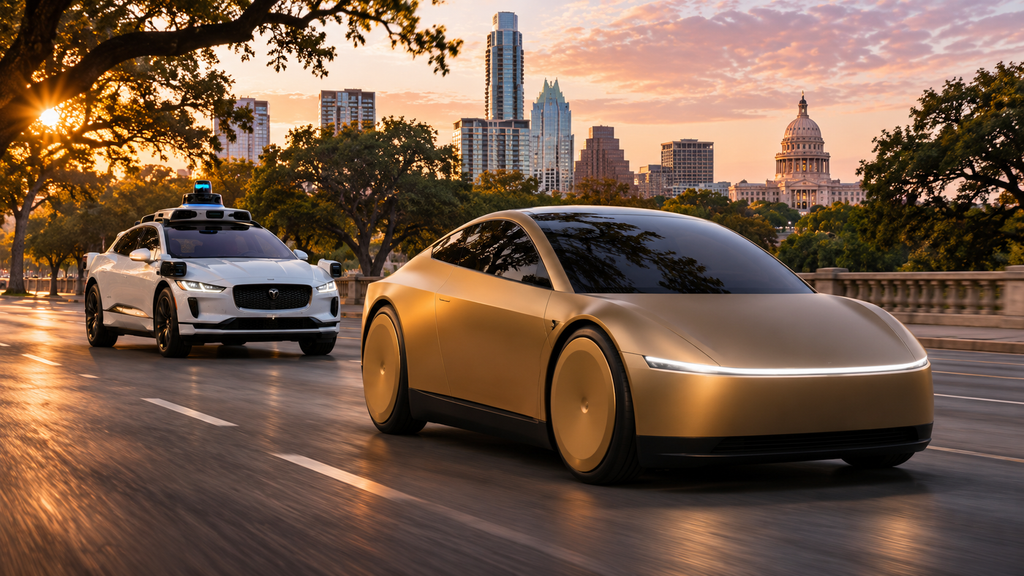
Waymo’s head start—and Tesla’s economic advantage
Waymo deserves enormous credit for taking autonomous transportation from a technological experiment to a commercial service operating in numerous American cities. By March 2026, it was reporting more than 500,000 paid rides per week. It has accumulated extensive real-world driving experience, navigated complicated regulatory environments and demonstrated that people will trust vehicles without human drivers.
Waymo has effectively established the market, giving it substantial advantages in operational experience, safety validation and customer confidence. But being first to establish a market and ultimately dominating it are two different things. History offers plenty of examples of pioneers overtaken by competitors that figured out how to deliver products more cheaply, conveniently or at greater scale.
One of the most fascinating aspects of this competition is the potentially enormous difference in vehicle economics.
Waymo’s familiar Jaguar I-PACE robotaxis have been estimated to cost approximately $150,000–$200,000 each, including the vehicle, autonomous driving hardware, computers and integration. Its next-generation Ojai, based on a platform manufactured by China’s Zeekr, should be considerably cheaper, with industry estimates suggesting approximately $100,000–$110,000 before certain final integration expenses.
Tesla’s Cybercab, meanwhile, occupies an entirely different price category. Tesla has begun offering selected customers the opportunity to purchase one for approximately $30,000, accompanied by a mandatory $299 monthly autonomous driving subscription.
These figures aren’t perfectly comparable. Waymo’s are estimated acquisition and equipment costs, while Tesla’s advertised figure is a retail price rather than its disclosed manufacturing cost. Nevertheless, even after Waymo’s anticipated cost reductions, its newest robotaxi may still cost roughly three to four times as much as a Cybercab.
Consider the implications if both companies wanted to deploy 100,000 vehicles. At hypothetical acquisition costs of $30,000 and $110,000, Tesla would need approximately $3 billion, compared with $11 billion for Waymo. That’s an $8 billion difference before other operating expenses.
Waymo could potentially offset some of that disadvantage through better utilization, longer vehicle life or operational efficiencies. But the capital difference is striking. And I suspect it’s only half the story.
Tesla’s manufacturing advantage: cost and speed
I recently listened to a podcast with former Tesla executive Jon McNeill, who described how Tesla’s engineers drew inspiration from Matchbox toy cars when developing its gigacasting manufacturing process.
Instead of assembling vehicle structures from hundreds of smaller components welded together, Tesla began producing large structural sections as single castings. McNeill suggested Tesla enjoyed an eight-year head start before competitors were able to adopt comparable techniques.
Whether the lead was precisely eight years isn’t really the point. Tesla has spent years rethinking how vehicles are manufactured, eliminating complexity and reducing components and manufacturing operations.
The Cybercab takes this philosophy considerably further. Tesla’s unboxed manufacturing process allows different vehicle sections to be assembled in parallel before final assembly, rather than moving a partially completed vehicle along a conventional production line.
During Tesla’s October 2026 earnings call, engineering executive Lars Moravy revealed that the Cybercab has approximately 50% fewer parts than any previous Tesla vehicle. Tesla also reports installed annual Cybercab production capacity exceeding 125,000 vehicles at Gigafactory Texas, with Moravy suggesting the line’s potential capacity is considerably higher.
In a subsequent interview, Moravy said Tesla was already capable of manufacturing Cybercabs faster than it could deploy them. The company is pursuing an extraordinarily ambitious ten-second production cycle time, although that’s a target rather than an established sustained production rate.
Another recent development makes this particularly interesting. On November 6, Elon Musk announced that Tesla would wind down Cybertruck production at Gigafactory Texas around mid-2027 to make room for additional Cybercab production.
The Cybertruck has struggled commercially, so the decision also acknowledges that it hasn’t become the business Tesla originally envisioned. But redirecting manufacturing resources toward Cybercab, on top of existing capacity, suggests Tesla is preparing for potentially enormous production volumes.
Tesla isn’t merely designing an inexpensive autonomous vehicle. It’s developing the capacity to manufacture enormous numbers of them at extraordinary speed.
And I wonder whether that second advantage could prove even more consequential than the first.
Waymo’s challenge isn’t just capacity. It’s speed.
Waymo isn’t standing still. It has partnered with Magna to equip vehicles with autonomous systems at its Arizona facility, which is intended eventually to produce tens of thousands of robotaxis annually. An October report suggested Waymo hopes to expand its fleet to approximately 20,000 vehicles by the end of 2027, roughly five times its reported fleet at the time.
That’s substantial growth. But compare the companies’ manufacturing approaches.
Waymo doesn’t manufacture its own vehicles. Its Jaguar I-PACEs were produced by Jaguar Land Rover, then delivered to another facility where Magna installed the cameras, lidar, radar, computers, specialized wiring and other autonomous driving equipment.
Its next-generation Ojai follows a similar model. Zeekr manufactures the vehicle in China and ships it to the United States, where Waymo and Magna integrate the autonomous technology. Although the new system is considerably simpler and cheaper, it still incorporates 13 cameras, four lidar sensors, six radar units and additional equipment.
Waymo’s vehicles are also larger, multi-row passenger vehicles, unlike Tesla’s minimalist two-seat Cybercab. That provides greater passenger capacity, a genuine advantage for certain journeys, but potentially adds manufacturing complexity.
The distinction is important. Tesla is designing the entire vehicle, autonomous system and manufacturing process as an integrated operation. Waymo depends on vehicle manufacturers, international supply chains, separate integration facilities and additional testing and validation.
Every manufacturing stage and logistical handoff potentially introduces time, cost and complexity. Of course, outsourcing can provide access to established manufacturing expertise and capacity without requiring Waymo to build its own factories.
Waymo is also improving its processes. It says its Arizona facility can send some completed vehicles into passenger service within 30 minutes of leaving the factory, although that measures final deployment rather than the entire manufacturing cycle.
We don’t yet have directly comparable figures for how long each company takes to manufacture and commission a vehicle. Nor has Tesla demonstrated sustained Cybercab production at its stated capacity.
Nevertheless, the differences in approach raise a fascinating question: If demand for autonomous transportation suddenly accelerates, which company can put tens of thousands of additional vehicles on the road most quickly?
Waymo is working toward capacity measured in tens of thousands of vehicles annually. Tesla already reports installed Cybercab capacity exceeding 125,000, with ambitions to go considerably higher.
Imagine both companies identifying an opportunity to expand into ten additional metropolitan areas. Waymo must coordinate vehicle production with its partners, transport the vehicles, integrate and validate the autonomous systems, and distribute the finished robotaxis.
Tesla could potentially manufacture purpose-built Cybercabs in enormous quantities through a highly integrated production process, then deploy them wherever regulatory approvals and operating infrastructure permit.
If Tesla executes that strategy, its advantage wouldn’t simply be cheaper vehicles. It could be the ability to expand its operating fleet dramatically faster, while committing substantially less capital per vehicle.
And closing a major gap in both cost and manufacturing speed would be an enormous undertaking for Waymo.
A possible progression: from pioneering to scale
This brings me back to what I’ve been seeing in Texas.
What struck me at COTA wasn’t simply the number of Cybercabs picking up passengers, but the fact that Tesla had extended its service into an area Waymo hadn’t yet reached. It made me wonder whether this might be an early indication of Tesla’s broader strategy: expanding aggressively into new locations, including suburbs and destinations beyond its competitors’ existing service areas.
Now I’m seeing Cybercabs around Irving. The Dallas–Fort Worth metroplex encompasses numerous cities and suburbs spread across a vast area. Waymo has established service in Dallas, but that doesn’t mean it covers the entire metroplex.
Tesla, meanwhile, has launched Model Y robotaxi operations in Dallas and Fort Worth, identified Dallas as its next Cybercab market, and reportedly has plans for robotaxi infrastructure in Irving.
My sightings don’t prove commercial Cybercab service is imminent here. The vehicles may simply be undergoing testing and validation. But they make me wonder whether Tesla intends to expand geographically much more aggressively than Waymo has so far, using its manufacturing advantages to make that possible.
I can imagine the market developing through four stages:
First, Waymo establishes the market. It demonstrates that fully autonomous transportation works commercially, establishes consumer confidence and develops substantial operational experience. It has already accomplished much of this.
Second, Tesla expands the geography. Rather than focusing exclusively on established urban service areas, Tesla extends coverage into suburbs, airports, sporting venues and other destinations where autonomous transportation remains limited or unavailable. My experience at COTA may offer an early glimpse of this strategy.
Third, manufacturing economics and speed change the competitive balance. If Tesla can manufacture vehicles for a fraction of Waymo’s cost and produce them considerably faster, it could deploy thousands of additional vehicles while competitors are still working through the economics and logistics of adding hundreds. That could translate into wider coverage, shorter waiting times and more attractive fares.
Finally, scale compounds the advantage. More vehicles mean shorter waits and greater convenience. Wider coverage attracts additional customers, generating revenue to support further expansion. And if one operator can deploy those vehicles faster and more cheaply than competitors, those advantages could become self-reinforcing.
At some point, the operator offering the broadest coverage, shortest waits and most attractive prices could become consumers’ default choice. Not necessarily because it developed the technology first, but because it made autonomous transportation affordable and available almost everywhere.
What could change the outcome?
There are plenty of reasons not to assume Tesla will win.
Waymo has a substantial lead in fully autonomous commercial operations, with valuable experience in safety, fleet management and regulatory relationships. Tesla still needs to demonstrate comparable reliability and safety across different cities, weather conditions and operating environments.
Regulatory approvals could prove a more significant constraint on Tesla’s expansion than manufacturing capacity. And manufacturing inexpensive vehicles isn’t the same thing as operating a profitable transportation network.
Charging, cleaning, maintenance, insurance, fleet management and utilization all matter. A $30,000 Cybercab sitting idle much of the day could be less profitable than a more expensive Waymo operating efficiently throughout the day.
Waymo’s larger vehicles can also serve groups that Cybercab cannot, and its partnerships may ultimately provide manufacturing flexibility and access to established transportation networks.
Nor should we assume that other competitors won’t emerge.
But if Tesla can achieve comparable autonomous driving performance while maintaining substantial advantages in manufacturing cost and speed, I suspect the competitive landscape could change surprisingly quickly.
A much bigger market than Uber
What fascinates me most is that we may be watching the creation of an entirely new transportation market.
Today, we tend to think of robotaxis as alternatives to Uber and Lyft. But what happens if autonomous transportation becomes dramatically cheaper and available almost everywhere?
Would families still need two or three cars? Could teenagers gain independence without owning a vehicle? Could older people who no longer drive regain mobility? Might suburban communities become less dependent on private car ownership?
These possibilities suggest a market that could eventually be much larger than today’s rideshare industry.
Waymo has demonstrated that autonomous transportation can work at meaningful commercial scale. Tesla appears to be pursuing a manufacturing and deployment model designed to make it inexpensive enough to become ubiquitous.
I wonder whether the decisive advantage in this market will ultimately belong not to the company with the greatest technological head start, but to the company capable of putting the most reliable vehicles on the road, in the most places, at the lowest cost—and doing so fastest.
Seeing Cybercabs coming and going at COTA, and now driving through the streets around Irving, makes me wonder whether we’re witnessing the early stages of that competition.
It’s much too early to declare a winner. But it will be fascinating to watch.
Leave a Reply
You must be logged in to post a comment.