<This is a speech I delivered at Il Casino, Restorante in Wellington at a surprise birthday for Dad’s 60th birthday on January 15, 2005 attended by more than 50 friends and family members. ‘Telegrams’ by people who were unable to attend follow, as does a list of the attendees.>
I’d like to thank you all for being here tonight to celebrate my father’s birthday. Let me also apologise to all of you whom I involved in organizing this event. I acknowledge that I was at times brash, overly demanding, blunt, impatient, intolerant and occasionally grumpy. My only plea is that these are all paternal traits. On the other hand, if the result is that this evening is a success on the scale of any of Roger’s achievements in the Past 60 years, then it will have been worth putting up with me.
There are only three people in this world who can call Roger “dad”: myself, my older brother Bernard and my younger brother Richard. My job tonight is to speak about Roger the father.
I was born in 1971, during the family’s three year posting to Brussels. As I have no memory of our time there, I can reflect on exactly half of dad’s 60 years. In my early years, Roger was for the most part working at the Treasury. And by that I mean that’s where he was, because to the best of my recollection he wasn’t at home.
Most of my memories of him over this period revolve around our holidays in Nelson, Taupo, Rotorua or Mount Hutt. And I’m glad to report that he usually did unwind on these trips. We all enjoyed getting outdoors and taking advantage of the lakes, rivers, mountains and bush of New Zealand.
True to his character, however, he would always bring a briefcase of papers and reports with him, and sometimes he went so far as to bring along work colleagues such as Bryce Wilkinson and Rob Cameron, although not in his briefcase.
To be fair, he was home from time to time. When I picture Roger at home during this period, I see him tending to his rhubarb patch below the sandpit he built for us or bottling apricots and peaches in the kitchen after a family excursion to an orchard.
It wasn’t until I was much older that I appreciated Roger as a father. Unlike some children of absent parents, I don’t ever recall resenting him not being there. This is because he chose an incredible mother for Bernard, Richard and myself. Because of his efforts at work and of sacrifices he made on his part and mum’s, we had very rich and fulfilling childhoods.
We were all able to play and learn whatever sports or instruments tickled our fancy, for however long we wanted. When we needed extra tuition or needed any help outside of school, there were seldom any questions asked.
Giving us these opportunities, however, came at a cost. And this is something I under-appreciated as I was growing up. While we were certainly not a poor family, nor were we wealthy. It was often with a sense of shame that I told my friends in the playground that my father worked in the public service.
In order for us to never go without, mum and dad put our interests first. For instance, I had wrongly assumed that:
i) dad was gardening and bottling for pleasure;
ii) he wore suits that were years out of date and held together by a thread because he had no fashion sense; and,
iii) he drove a crappy scooter to work in a bright red rubber suit because he thought it was cool.
It was around the end of this period of my life that I began to appreciate how talented dad was. It was also around this period of my life that I worked out what the private sector was. And it didn’t take me long to work out how much better off we would be if dad worked there.
So imagine my delight when dad came home and told us he was leaving the Treasury to work for something called the “New Zealand Business Roundtable”. And next, imagine my sheer and utter horror when he told us it was a non-profit organisation. I was completely crestfallen. I may have even gone to my room and cried.
Dad proved a lot more useful between the ages of 13 and 17. Not because he was home more often. He wasn’t. But because I started getting homework that Mum couldn’t help with. Algebra, statistics and French are not Mum’s strong suits.
The rhubarb garden disappeared around the time of the Roundtable and bottling became rare. We also had some home renovations. My memories of Roger during this era have him working in a different room in the house and us venturing further south for ski holidays. Life was otherwise more or less the same.
One other enduring memory of this time was of Roderick Deane regularly paying dad visits late in the evening while walking his dog. At this point in my life I still had very little understanding of what Dad actually did when he wasn’t bottling or moaning about the mess us kids had left around the house.
Later, I realised these visits probably weren’t to discuss Roderick’s Labrador but how to drag New Zealand out of the stone age and into the modern world. It was also several more years before I realised what role Roger played in New Zealand’s reforms or the scale of the obstacles faced by him and everyone else involved, including many of you here tonight.
(As an aside, if the New Year’s Honours list is anything to go by, there is still some work to do. I noticed that there were as many honours for business as there were for pottery, speedway racing and — I kid you not — for services to welfare work in Mongolian prisons. Each, including business, received one.)
My only insight into Roger’s work at this point in my life came one school holiday when I myself worked at the Treasury as a general dogsbody, long after Dad had left. I haven’t in fact shared this story with anyone except my mother and I probably risk the wrath of the Privacy Commissioner by divulging this information.
My summer job involved crunching numbers in spreadsheets as well as general clerical tasks. One day, someone in the office asked me to take a box to the basement to be stored. I took the elevator downstairs and unlocked the door to the archive room. When I stepped in, the door swung shut with the key on the outside. I was locked in and there was no one around.
For five or ten minutes I tried to work the door or yell out on the off chance someone would hear me, but to no avail. Not one to waste time, another trait I inherited from my father, I decided to occupy myself while I waited for someone to become aware of my plight and set me free.
I began poking around the boxes and came across a stack that, according to the labels, held old personnel files. So, and you’ve probably guessed it already, I figured out when Dad left the Treasury and located his.
The main insight into Roger that I uncovered was in what these days would be called his performance review. I browsed through the various categories he was measured on and read the typed comments. On page two or three one particular comment stuck in my mind and that was under the heading of ‘Working with others’. It said, “Roger does not have a lot of time for people who are less capable or who pick up on things slower than him.”
I continued reading through the review and noticed that there was a column where the employee being assessed is allowed to write their own comment by hand. This is where the person is expected to write something like, “I will address this by focusing on x, y & z next quarter.” So I went back to the comment regarding Roger having little time for less capable employees to see what he’d written. In the column, he had scrawled a brief, “Agree”.
Not long after I escaped the dungeons of the Treasury, I entered university. As a father, Roger never overtly pushed any of us to perform academically. He provided a little guidance on which courses to take if we asked. But otherwise we were free to pursue any discipline we liked. And for this I’m grateful.
On the other hand, he was a very hard man to please. Thankfully, he seems to have mellowed somewhat over time. A good illustration of both of these points came when I pursued postgraduate studies in the United States. I clearly remember a conversation we had when I called him up shortly after receiving what I thought was terrific news. I’d been elected into the honour society for US business students. The phone call went like this:
“Hi Nicholas. How are the studies?”
“Everything’s going really well. I just found out I got elected into Beta Gamma Sigma. It’s the honour society for the top 20% of business students in the US”, I said, rather proudly.
“Oh. That’s good. So where did you come?” Roger asked.
“Uh. In the top 20% dad.”
“Yeah, but where. Were you in the top 10%?”
“Uh. I don’t know dad, they don’t tell you that,” I replied, somewhat dejectedly.
“Well, can you guess?” he asked.
“Not really dad. I might have come in the top 10%, but I don’t really know,” I said.
“Oh,” he said, followed by a brief pause. “What’s the weather like over there? Is it still snowing?”
This sort of conversation was typical of most of our conversations around academic results as I grew up. I did mention, however, that he has mellowed. And this was exemplified six months after this conversation took place. I received the book of the latest Sir Ronald Trotter lecture in December with the Christmas card bookmark. Yes, these are gifts for sons as well.
I’ve kept the bookmark and treasure it as on it were words I don’t recall him using much for any of us in the past. He had written, “Nicholas, I’m very proud of your achievements this year. Love from Dad.”
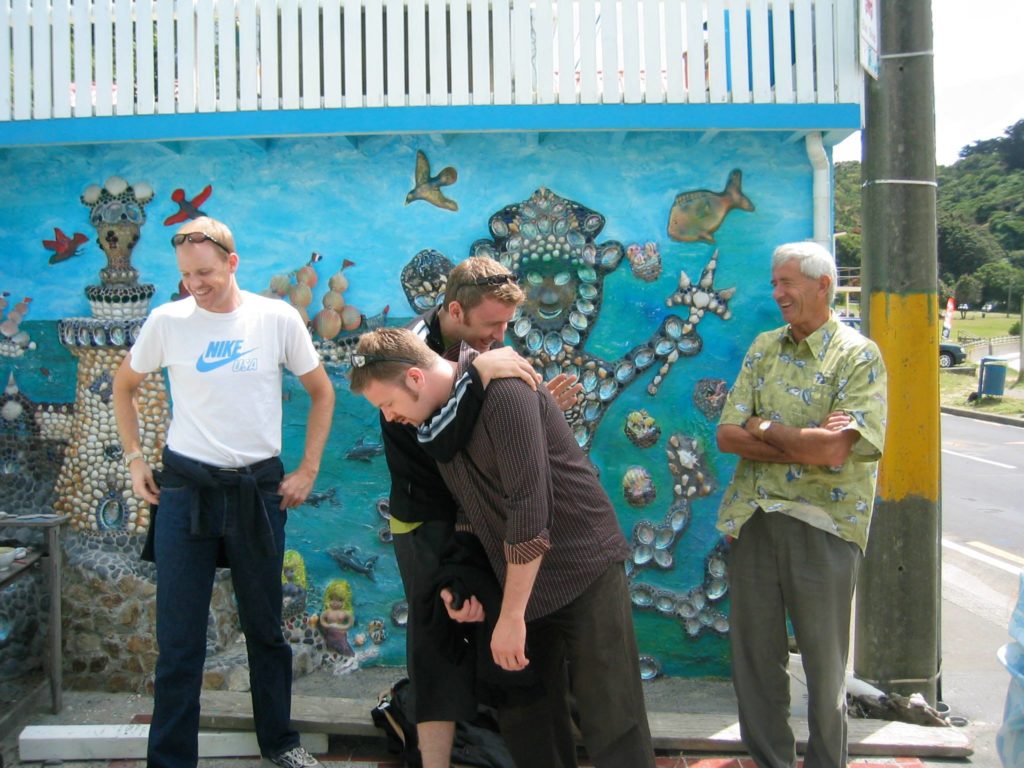
It took me a long time to appreciate the role Roger played in the family and what he’d done and sacrificed in order to raise what I think are three pretty decent kids. As we celebrate his achievements over 60 years, I hope I’ve allowed you to understand the job he’s done as a father. I wouldn’t wish for any other.
TELEGRAMS
The following are ‘telegrams’ sent to me by invitees who couldn’t make it tonight:
1. Jenny Gibbs, Auckland
Dear Roger,
You have been a shining beacon for me for so many years.
Your courage, enthusiasm, conviction, integrity and good humour have often been one of the few reasons reasons to remain in New Zealand.
I salute you and hug you – wish I could be there.
Love, Jenny Gibbs
2. Richard Epstein, University of Chicago
Roger,
I have known you now for over 15 years, and yet you never cease to amaze me. I do not quite know the mixture of childhood influences, near Nelson, and formative experiences at university, in the Treasury, and now at the NZBR that have shaped you. I cannot tell causes, but only can judge effects. And yours are quite extraordinary.
Most people who run and organise think tanks and similar organisations have a tendency to bend toward the wind in response to a set of pressures to which you have been completely impervious. Most people are willing to let their fundamental insights be lost in a sea of qualifications that never make as much sense as the central principle. Yet you have never allowed fashionable ideas to divert you for a second, while your own sense of intellectual curiosity and honesty has kept you abreast of those ideas that truly are correct, and should work themselves into the fabric of discourse.
And of course the work ethic. Dealing with you means that the whole notion of late performance and moral hazard simply has to be put to one side. It is said sometimes that the belief in laissez faire builds character, for those who are committed to punctuality in performance of contracts as an abstract ideal, live it day-to-day in practice. And you are the best example of that I have ever encountered, whether it be on matters large and small.
And the gains are equally shared. Your small operation has done more good for the world than all other business roundtables world-wide I suspect, and certainly in the United States, I am sure.
So on this occasion, my warmest regards to you, Margaret and the boys, Richard, Nicholas and Bernard, if memory serves me well. And Eileen, Melissa, Daniel, Benjamin, and Elliot join in from afar, for they too have been the beneficiaries of your hospitality on numerous occasions.
Here’s to the next visit to New Zealand!
Warmest regards and heartiest congratulations,
Richard
3. Murray Horn, ANZ Bank, Sydney, Australia
Roger,
We have worked together in a number of different roles over a long period of time and I have very much enjoyed and been enriched by our association.
It is hard for me to think of you as 60 years old because you are so optimistic and so very energetic. I stopped measuring myself against you a long time ago because I did not like thinking of myself as a slacker!
It is not in your nature to look backwards. When you finally allow yourself that luxury, I hope you appreciate the tremendous contribution you have made to the development of our community.
I am sorry I can not be with you and our mutual friends today. Wishing you a long, healthy and continuously productive life.
Murray Horn
4. Richard Prebble, Member of Parliament, Wellington
Roger,
You are a National living treasure and living proof of Hayek’s claim that it’s think tanks not politicians that change the world.
Happy Birthday
Richard Prebble
5. Christine Fernyhough, Auckland
What of the poet? There is a passage in David Malouf’s ‘An Imaginary Life’ that has had held such influence over my thinking, it starts – “I was stopped in my tracks by a little puff of scarlet amongst the wild corn. Scarlet! It is the first colour I have seen in months. Or so it seems. Scarlet. A little wild poppy, of a red so sudden it made my blood stop”
Every once in a while I have met someone who startles and stops me in my tracks —”a little puff of scarlet amongst the wild corn.”
I recognize you because of Malouf.
Happy birthday dear Roger.
Christine Fernyhough
6. Simon Walker and Mary Strang, London
As Lenin and Mao both knew, every revolution has its leaders. But the title “Hero of the Revolution” is reserved for those who truly made a difference and moved the earth under our feet.
No one has made more of a difference to New Zealand than Roger. His dogged determination, steady application and consistent focus on the real issues has had a huge impact on us all. Britain, Australia and the US would all have been fortunate to have him around – but he stayed where he really belonged.
He’s a great guy – and a good and loyal friend. Given his level of health and fitness, he should be drawing superannuation for a long while yet. We hope to share much good cheer and laughter in the decades ahead.
Much love and all the best from Simon, Mary, Jeremy & Gini.
7. Norman LaRocque, New Zealand Business Roundtable
I’m sorry I got called away at the last minute to Washington DC to attend a series of World Bank meetings and have had to miss your 60th birthday party. Leslie and I were really looking forward to joining you in celebrating. It has been a pleasure working with you in various capacities since we moved to New Zealand in 1992. You have made a tremendous contribution to public policy in New Zealand and we look forward to much more.
Leslie and I wish you all the best on this important occasion.
All the best. Norman LaRocque and Leslie Macintosh
IN ATTENDANCE
Alan & Hazel Kerr
Alan Gibbs
Barbara & Ron Taylor
Barrie & Linda Saunders
Bernard Kerr and Siri Dayton
Bill & Karen Day
Bryce & Lee Wilkinson
Catherine Judd
David & Marie Leonard
Diane Foreman
Don and Mrs Jelan Brash
Douglas Myers
Graham & Claudia Scott
Greg Dwyer
Heather & Peter Kavanagh
Ian & Jocelyn Fraser
Margaret Northcroft
Michael Irwin
Nicholas Kerr
Nick & Diana Bridge
Peter Shirtcliffe
Ray & Jill Evans
Richard & Jill Bromley
Richard Kerr
Rob & Maureen Cameron
Rob McLeod & Joanne Hodges
Roderick & Gillian Deane
Ruth Richardson and Andrew Wright
Sir Gil and Lady Joy Simpson
Sir Roger Douglas
Sir Ron Trotter & Lady Margaret Trotter
Stephen and Cathy Franks
Leave a Reply
You must be logged in to post a comment.