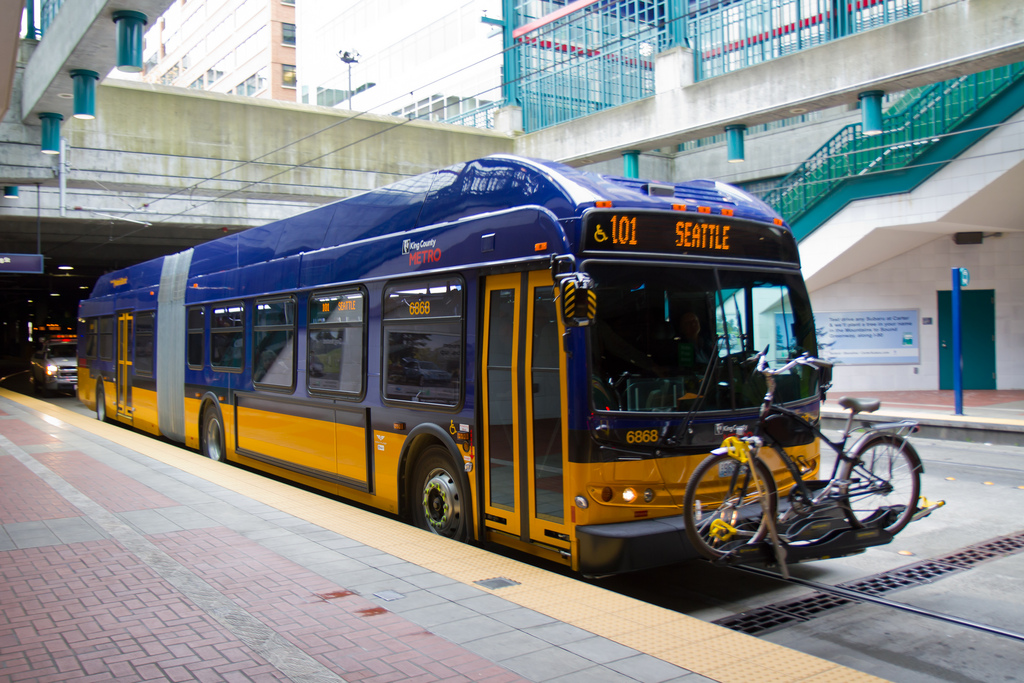
 Metro bus users and taxpayers should rejoice that Seattle is soliciting bids from companies to fund, design and replace bus shelters, benches, trash cans and information signs. In addition, residents will benefit from a requirement that the winning vendor must maintain them to higher standards than King County Metro currently provides. The company will recoup its costs through advertising. As the Seattle Department of Transportation (SDOT) noted when making the announcement, similar programs in Paris and throughout the U.S. have been run successfully for years.
Why stop at just asking private companies to take care of the shelters? Like other communities across the globe, King County should competitively contract its bus operations. The county would still determine routes, timetables, fares and standards. However, like SDOT’s process for new street furniture, companies would submit competitive bids to operate routes. Not only is this a common practice that has benefited riders and taxpayers alike in other states and cities around the world, it’s the same approach we take for school buses in Seattle and Snohomish County takes with numerous Community Transit routes.
In 1992, I witnessed first-hand the transformative effect of competitive contracting on Wellington’s bus service. Following legislation passed by New Zealand’s central government that required funding and service delivery be separated, Wellington’s local government contracted its bus and tram operations. The Scottish company Stagecoach was the first successful bidder and almost overnight users like me were enjoying brand new buses, lower fares and increased service. Better yet from a taxpayer perspective, within six years ridership had increased 24% and the NZ$15 million subsidy the council paid before Stagecoach took over operations had fallen by more than 50% to around $6 million.
Wellington’s experience is typical of dozens of other cities that have opened their public transportation to a contracting process in recent decades, including those in the US, Canada, UK, France, Germany, Italy, Belgium, Poland and Australia. And it’s long been the norm for private companies to operate public transport in Japan, Hong Kong, South Korea and South America.
London’s public transport costs were skyrocketing prior to 1985, which resulted in the British Parliament passing legislation requiring competitive contracting. Within 15 years, Transport for London – which is responsible for the world’s largest public transport system – saw ridership increase 30%, service levels increase 42% and overall expenditures fall 26%. Because service expanded, costs per mile fell even further to 48% of the level prior to 1985.
San Diego underwent a similar process five years earlier in 1980 and enjoyed the same sorts of dramatic improvements in the form of increased ridership and service along with lower costs. Seattle’s neighbors in Snohomish County have competitively contracted bus services for more than two decades, with the company First Transit currently operating Community Transit’s “Sound Transit Regional Express Bus Services” and a portion of its commuter routes to downtown Seattle. These services are operated at costs significantly below Community Transit’s in-house services and King County Metro’s.
SDOT identified 49 routes last year that are either overcrowded or chronically late, impacting thousands of riders. Residents are regularly asked for temporary or permanent sources of increased funding for Metro, most recently in last year’s Proposition 1 which resulted in a temporary $60 additional car-tab fee. Soliciting bids for bus shelters and street furniture should be just a first step. Our school children shouldn’t be the only ones benefiting from competitive contracting of bus services. Seattle’s bus riders and taxpayers alike stand to gain from companies bidding to operate Metro buses, just as hundreds of millions of people around the world have benefited in their own cities.
Originally posted at Sound Politics.
Leave a Reply
You must be logged in to post a comment.